

Curiosity of the unknown and the pursuit of a better life have always pushed man to travel. In order to reach these goals science and education were saddled up in the duty of trade and exploration - initially to benefit the big sea empires and lately for the benefit of humanity. Sails were the first great force in building the world economy.
Briefly - sails became the engine of civilization. For thousands of years sails built the world-economy. They traded spicies, sugar, tea, timber and finecloth, tied the continents together and created imperiums. From cogs and caravels to East Indiamen and clippers, ships evolved steadily, expanding their trade and power. Hanse, Venice, Holland and England became the superpowers of the seas. Sails made the world global.
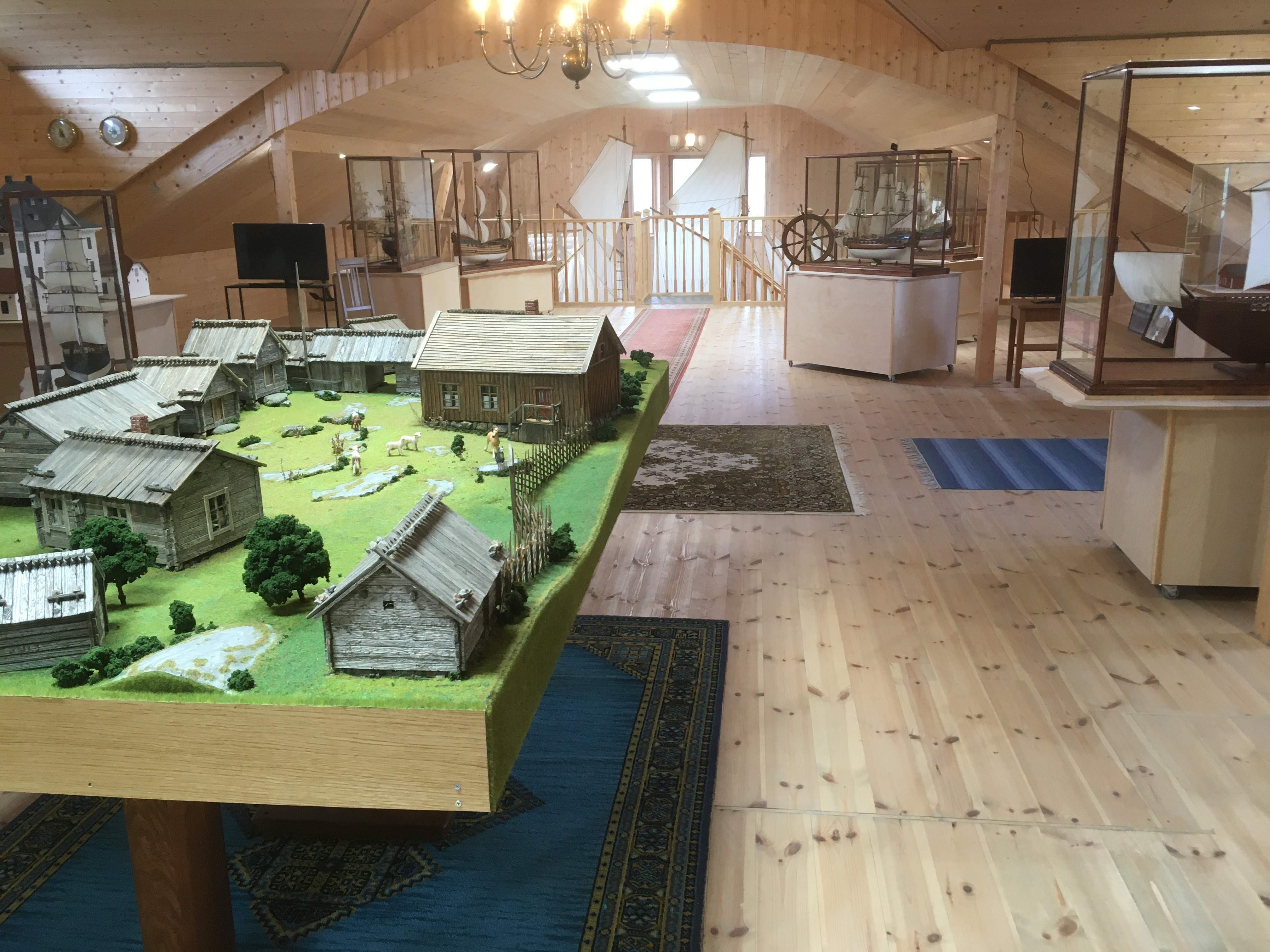
The hayloft featuring a nordic galleass and a live fish vessel - freight sump.
The HISTORICAL SHIP'S ROOM is the first room in the House of Knowledge, where over time has been gathered a multitude of modelships - united by commercial sailtrade. The significance of the Alandic sailingtrade must not be underestimated - Alandic peasants sailtrade laid the foundation long before the days of Gustaf Erikson. A farm environment from the early days of peasant trade has also sneaked in here.
THE BALTIC ROOM, houses the two first 1:5 scale shipmodels. The nordic galleass ELSA and the live fish freight vessel SIGRID meet athwartships. Peasant trade in the southwestern Finland mainly sailed the Baltic Sea to the environments of Stockholm, thus the name of the exhibitionroom.
The oldest known long distance trade is said to have been between Mesopotamia (Iran/Iraq) and the Indus-valley, current Pakistan. Trade started ca 3000 BC and the goods were, not unexpectedly, valuables like spices, cloth and precious metal. Ca 2000 BC Cyprus entered the trade-area exporting copper to the Egyptian Pharaohs. Phoenicians were not the firsts to conduct trade on the Mediterranean Sea. Credit goes to the Greek Island Cultures, Minoan Crete and Mycenaean Peloponnesos. The Egyptian Pharaohs conducted trade with Lebanon and the mytical Punt realm, asumed to be near the Horn Afrika.
The Phoenician strategy to secure the Seawayswas to establish trade stations, which with time evolved into significant trade cities along the Coast of the Mediterranean Sea. As Phoenician Trade developed it surpassed all other trading cultures of the time. Phoenician also conducted trade with self-produced goods, of which exclusively colored glass-craft is best known. Phoenicians developed the 360 degree protractor which together with Polaris and other developments eased offshore navigation. The Phoenician alphabet is the foundation of our western alphabet. The name Biblia derives from the town of Byblos, neighboring town of Tyre, the largest Phoenician town.
Mappa di Eratostene.
Phoenicia (Phoenician merchant ship)Phoenicians were the best ship builders and navigators of their time, ca 1500 – 500 BC. In the beginning trade was carried aut in small, modest coastal vessels. Under the voyage coast was in sight and for the nights the skipper prefered to attach ashore. Shortly the cunning Phoenicians learned to navigate offshore, utilizing astronomic points in the sky, mainly the Polaris. The seaworthy Phoenicians were first to sail through Gibraltar strait, the mythical Pillars of Hercules, to the English Channel and further to the Baltic Sea trading for amber on the North-German coast.
From end of 15th century the dutchmen started a sedulous work to renew and optimize the merchant fleet. The guideline was innovative economic thinking. Operational costs had priority in every aspect. The goal was to lower building costs, to diminish the crew and gain greater carrying capacity pervessel. The result of the challenge was the flute ship, fluyt in dutch, which made the other maritime nations follow. along. The flute was constructed and adapted for three major trades, the Atlantic and Ocean traffic to South-east Asia, for the Mediterranean and for the Baltic Sea. The first flutes were built in the 1590s. In the design the hull was prolonged, and almost flatbottomed the draft was minimized, especially important for the flutes built for the Baltic Sea and the Finnish Gulf. Likewise the flute's principal duty to carry goods was considered. She was less rigidly built from pine exported from Norway and Balticum.
De Vrede van Amsterdam Flute ship Jutholmen wreck c. 1700
This model is shown in the main collection, alongside with a dozen others from different epochs. This ship was smaller and sailed the North Sea and the Baltic Sea. The bigger ones mostly sailed Sout-East Asia, China and the Spice Islands (Molucs).
With the sailing fish vessel - the freight sump - live pike was shipped in a big sump in the aft. The yacht was a smaller one-masted cargo vessel. The galleass was two-masted and the scooner three-masted.
Subsistence sailtrade was to bring their own products for sale directly to the consumer. For Brändö the nearest market was Turku, but Stockholm and Reval were frequently visited. Some products were exchanged, such as herring to grain, normally rye. Subsistence sailtrade was part of homesteading, ready cash was rarely used.
The traffic continued for centuries without substantially changing. The cause; The Bothnian Trade Monopoly and the guild system, which safeguarded the Stockholmian borgeoisie from competition.
Sailing trade got wind in the sails. At the end of the period 1925 peasant ship-owners established their own bank. Everywhere in the goods and service providing arhipelago economy there is an air of trust in the future.
In the 1840s the guild system was terminated. Now there grew opportunities for entrepeneurship and possibility to stand on own feet. The dream of sailing trade on own keel was possible to implement. Yacht trading on the Baltic Sea to begin with and later on the North Sea, was to dominate the economy of the small arcgipelago villages until 1940 when war broke out. In Torsholma and Lappo the galleass trade continued still during the 1960s.
First known yacht skippers of Lappo were the Andersson brothers from Pellas homestead. They conducted sailtrade between Ostrobotnia and Stockholm with a sel-built galleass for some years in 1750.
A new attempt was ministered from Pellas in 1800s with a freight sump, also self-built. In the beginning of 1850s the brothers Henrik and Karl Gustaf Nordberg from Norrgårds homestead aquired the galleass Fortuna. Now the trade gets going. Henrik, married to Fiskö, becomes the leading force amongst the skippers in the community. The heyday of peasant trade starts and persists until the war breaks out 1939.
During the whole second half of the 19th century yachts from Brändö and other islands in the archipelago conduct the most vivid trade in the Baltic Sea.
In the 1870s to scooners were aquired, the bigger John a vessel of 330 register tons was often sailing the Archangelsk - England trade.
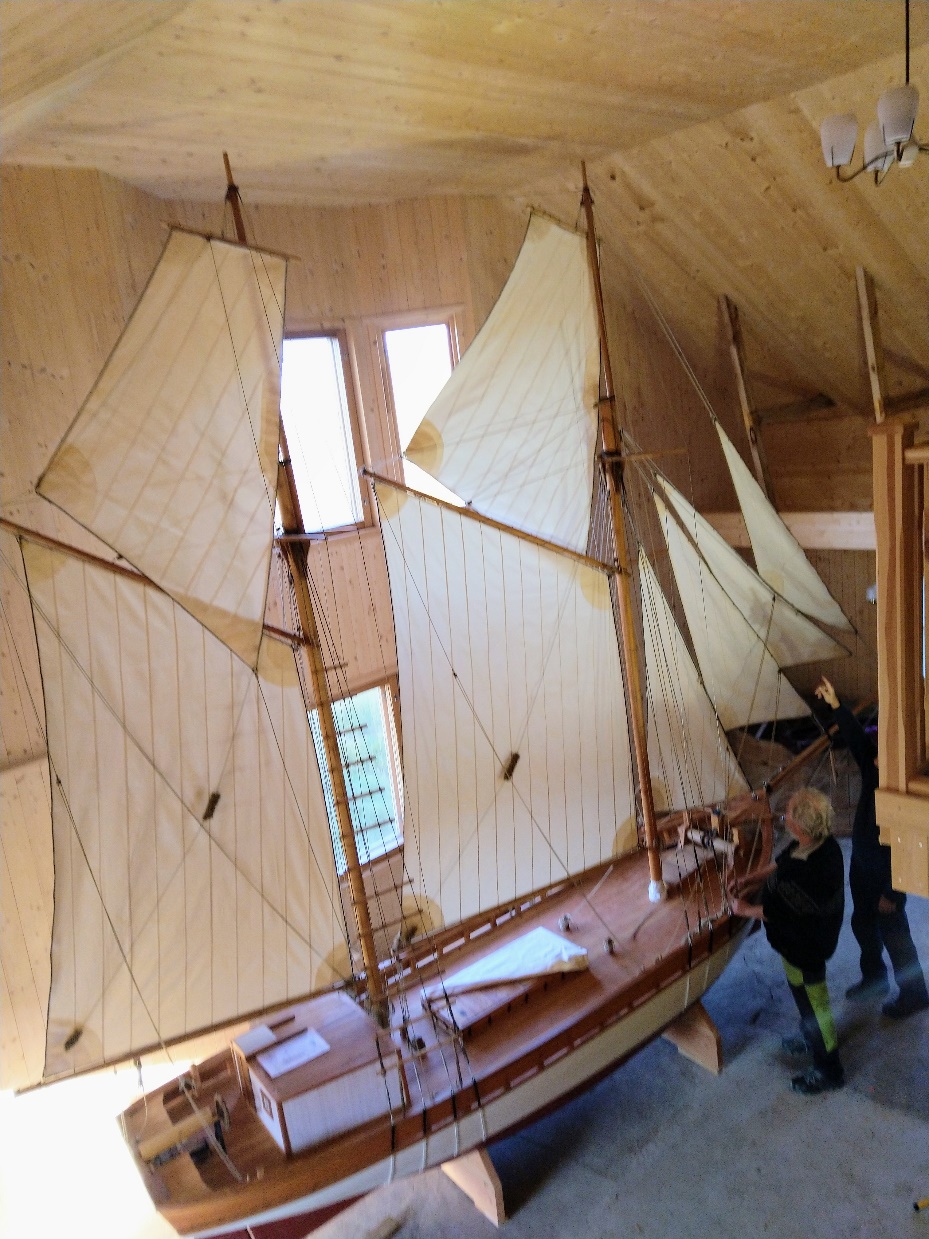
The galleass ELSA in the Baltic room.